Open Community Leadership: What Is That?
I’ve been meaning to write this for months.
I was so busy building OCL and running its first workshops that I never found time to announce it properly. By the time I sat down to write, people were already using it. The project is called Open Community Leadership, or OCL. It started as a problem I kept running into, and kept hearing about whenever I sat down with another community leader who looked tired.
OCL is an open-source project for the people who build communities: organizers, maintainers, volunteers, mentors, and those quietly holding everything together while somebody else is on stage.
The problem of sustainability
Over the years, I kept seeing the same pattern in different communities. A meetup had plenty of attendees but nobody ready to become the next organizer. A project attracted contributors, but one person still made every decision. A conference had enthusiastic volunteers, yet much of the knowledge remained with the same small group.
Everything appeared to be working. Underneath, the people holding it together were tired. Funding and tooling dominate conversations about open source sustainability. They matter, of course, but communities also rely on human infrastructure: people who welcome newcomers, mentor contributors, resolve conflicts, organize volunteers, and notice when somebody quietly disappears.
These people carry knowledge that keeps communities alive. They are usually expected to acquire it through experience and sustain it through passion.
Many people told me they don’t know how to start a community. But the truth is, we know how to start communities. We are just less prepared to sustain them.
Open source is extremely valuable. Companies, governments, schools, and entire industries depend on it. Meanwhile, many of the people caring for its communities continue without enough preparation, recognition, or support.
I organized my first event when I was 17. Since then, I have worked with meetups, conferences, open-source projects, volunteer groups, and communities in different countries and cultures.
The names changed, the platforms differed. But the same problems kept returning to the discussion table.
How do we help a newcomer take their first step? How do we turn participants into contributors, and contributors into people who can guide others? How do we hand someone real responsibility instead of giving them more unpaid work? And what happens when the person who knows everything gets tired, moves away, changes jobs, or finally decides they would like to sleep?
The knowledge we rarely document
Open source is very good at documenting technical systems. We can explain how to install a project, submit a patch, run the tests, etc, etc.
The knowledge that sustains a community is harder to find. It is the judgement people develop through experience: noticing what others need and dealing with problems before they grow.
Most community leaders learn this by doing the work, making mistakes in front of real people, and trying again. Schools and workplaces rarely teach it. Even when leaders are willing to share what they know, few have the time to turn years of experience into something another person can learn from.
When they leave, their knowledge often leaves with them. The next person starts from zero. Most well-established communities will have a README for installing a project, or a process for getting the system running. We do not always have one preparing the person who will lead the community, or the project, six months from now. That is the gap OCL is trying to close.
For OCL, sustainability means regeneration: a community’s ability to keep creating people who can contribute, mentor, make decisions, and eventually lead.
The experience is the community
When communities struggle, we often reach for tools first. Should we move from Slack to Discord? How about redesigning the website? Do we need a different way to review the PRs? Or perhaps another form will solve it. Humanity has created many forms.
Tools influence a community, but people decide whether to stay based on their experience inside it.
A newcomer remembers whether anybody noticed them. A contributor remembers whether their work mattered. A volunteer remembers whether they were trusted to do more, or simply given more work.
People also remember whether they felt safe enough to make a mistake, whether they formed relationships, and whether the community offered somewhere for them to grow. People may say they stopped coming because they became busy. But sometimes the community stopped giving them a reason to return.
That returning person makes a difference. They may become a contributor, organizer, mentor, or leader. A community’s future often begins with whether someone comes back a second time.
The experience is what makes people stay. It is also what makes them leave.
Giving the pattern a name
At the centre of OCL is a framework I call POPCOM. It looks at six parts of community life:
- Participation: How people join.
- Ownership: How people gain responsibility.
- Purpose: Why people stay.
- Connection: How relationships form.
- Opportunity: How contributors grow.
- Mentorship: How communities create their next generation.
These are the six dimensions I’ve identified around sustaining communities, and they’re connected. Participation can bring people into a room, but Connection gives them a reason to return. Ownership without Mentorship can feel like being handed the keys to a factory and told “good luck.”
A community may have many willing helpers while offering no clear path towards leadership. That is Purpose without Opportunity. And when knowledge and responsibility remain with the same small group, a community can look successful right up until those people get burned out.
POPCOM gives us a shared language for recognizing these patterns. OCL turns that language into practical modules, workshops, canvases, and exercises that community leaders can use in their own contexts. Each module stands on its own and could be learned without depending on the other.
OCL exists to show that community leadership can be learned. These are skills rather than mysterious talents. They can be practiced and passed on.
Three ways to learn
There are three ways to use these modules: self-guided, workshop, and mentoring. The self-guided path is available for anyone who wants to work through a module in their own time. Workshops bring community leaders together to compare experiences and work through real situations. The mentor path helps people take that learning back into their own communities.
I have insisted on workshops from the beginning because ten people can read the same guide and understand it in ten different ways. Leadership becomes real when people discuss a difficult situation, listen to how others would approach it, test an idea, and reflect on what happened.
The aim is a ripple effect. Someone attends a workshop, takes the open materials back to their community, adapts them to the local context, and shares what they learned with the people around them.
That is how community knowledge should travel: person to person and community to community.
Turning idea into reality
The first OCL workshop is called The Experience Is the Community. I have now delivered it at EuroPython 2026 and PyCon LATAM 2026.
Participants begin by thinking about communities they stayed in and communities they left. They then map one of their own communities across eight stages: Arrival. Welcome. Participation. Connection. Recognition. Growth. Safety. Return. The goal is not to produce a beautiful diagram where everything is green and everybody goes home feeling impressive.
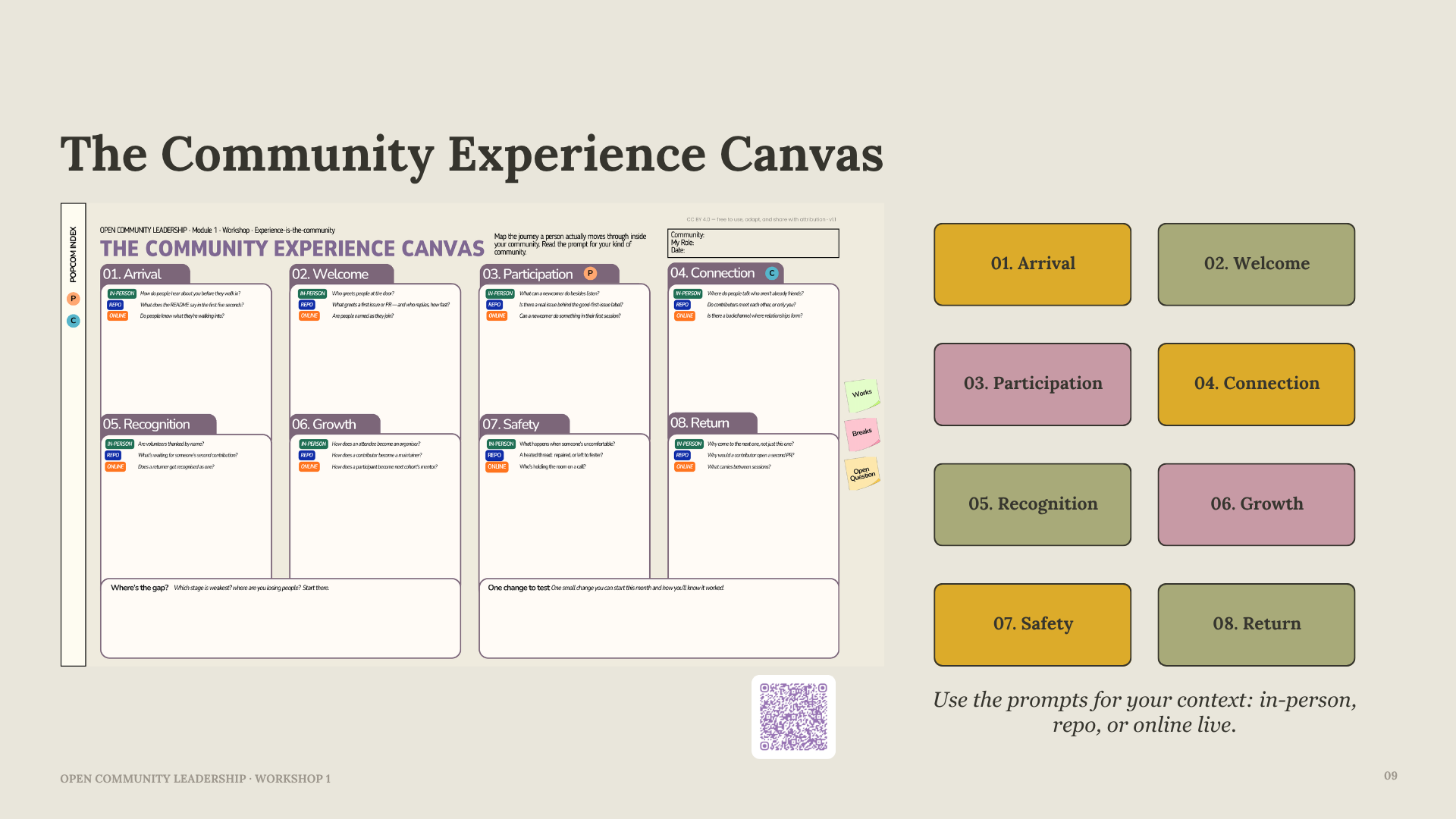
The Community Canvas
The goal is an honest account of the experience. Where might someone quietly disappear? What is missing? What is one practical change we can test? Yeah, just one.
Community leaders are extremely talented at leaving a workshop with seventeen ideas and enough new work to ruin the following month. A small improvement that happens is usually more useful than a transformation plan that remains in a notebook. Running the workshop also changed the project for me. A framework can look sensible on paper. Put it in a room with real community leaders, limited time, different levels of experience, and actual pens, and you quickly discover what is clear and what still needs work.
That is why OCL is being built in the open. It has to grow through use, feedback, and adaptation by people working in communities that look nothing like mine.
More than just Python
My strongest base is the Python community. My work with the Python Software Foundation’s Diversity and Inclusion Workgroup connects me with organizers from many regions. Other community networks like Python Asia Organization, Djangonaut Space and Black Python Devs bring in people from different Python communities. I recently sat down with Djangonaut Space to talk through their mentorship model — the interview is in the research archive.Their experiences help OCL avoid being built around one culture, one region, or one definition of a successful community.
These problems extend far beyond Python. Succession, volunteer retention, conflict, burnout, mentorship, and sustainable governance appear across open-source ecosystems. Every community has its own context. The tools should be adaptable enough to respect it while still letting us learn from each other. The materials are released under a Creative Commons license. You can use them, adapt them, translate them, and share them with attribution.
OCL was created for the open source community. A meetup organizer should be able to use the exercises with their team. A maintainer should be able to adapt a module for an open-source project. A conference organizer should be able to translate a canvas for their local community.
Someone should be able to improve an activity, share what they learned, and make the next version more useful. There is no single model of community that works everywhere. Culture, language, access, resources, and local history all shape how a community works. OCL should help each community understand itself, learn from others, and make deliberate choices about the experience it creates.
The support makes a difference
The project is being developed with the support of the Sovereign Tech Agency fellowship. My fellowship gives me time to turn years of community experience into resources other people can use. That kind of support is still rare, and it makes a real difference.
Funding gives people time. The people who understand community work best have seldom had time to turn what they know into learnable materials. Right now, I have some of that time and I want to use it well.
OCL is for people welcoming newcomers, following up with missing volunteers, documenting what only they know, and making room for somebody else to lead. It is also for the organizer wondering what would happen if they stopped. This is only the beginning.
You can explore OCL, use the first module, run the workshop, or look through the project on GitHub.
I’ll also bring OCL to PyConFR in Biarritz, where I’ll give a keynote, Sustaining Open Source for the Future, and run the workshop. If you’re coming to the conference, I’ll see you there!
And if you have built a community, made mistakes in front of people, and kept going, you already have knowledge worth sharing. I would love to learn from you.