AI Did Not Break Education. It Revealed the Bug.
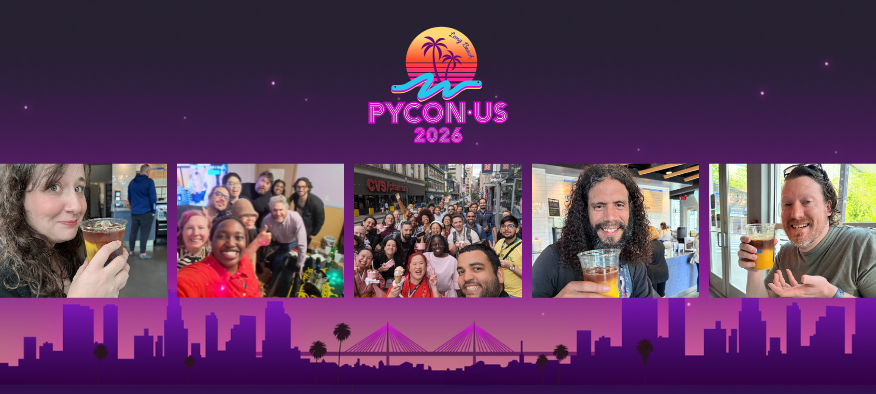
When Gi from Python Singapore invited me to speak at PyCon Singapore, I decided it was time to explain why I had left.
The talk was called So Kiasu, Still Kena Replaced by AI. It is a very Singaporean title. You need at least a little local context to fully appreciate kiasu and kena.
Not many people in the Python community knew that I was born in Singapore. Fewer knew the circumstances in which I had left. Even fewer knew that I had once trained to become a teacher there, or why I walked away after one year.
I did not leave because I disliked teaching. I loved working with children and helping them understand something that had previously felt impossible.
I left because the education system I entered seemed more concerned with completing the syllabus than making sure students were learning.
That disappointment stayed with me for more than twenty years.
So when I began preparing a talk about AI, I found myself returning to the same questions.
What is education for?
What makes someone a good teacher?
And what happens when a system built around producing correct answers meets technology that can generate those answers in seconds?
For most of my adult life, I had told the story in fragments. I had left Singapore. I had moved to France. Later, I moved to the Netherlands. Somewhere in between, I had learned Python, joined open-source communities, organised conferences, and eventually became a Board Director of the Python Software Foundation.
That version had a clean line through it.
The true version did not.
Afraid to Lose
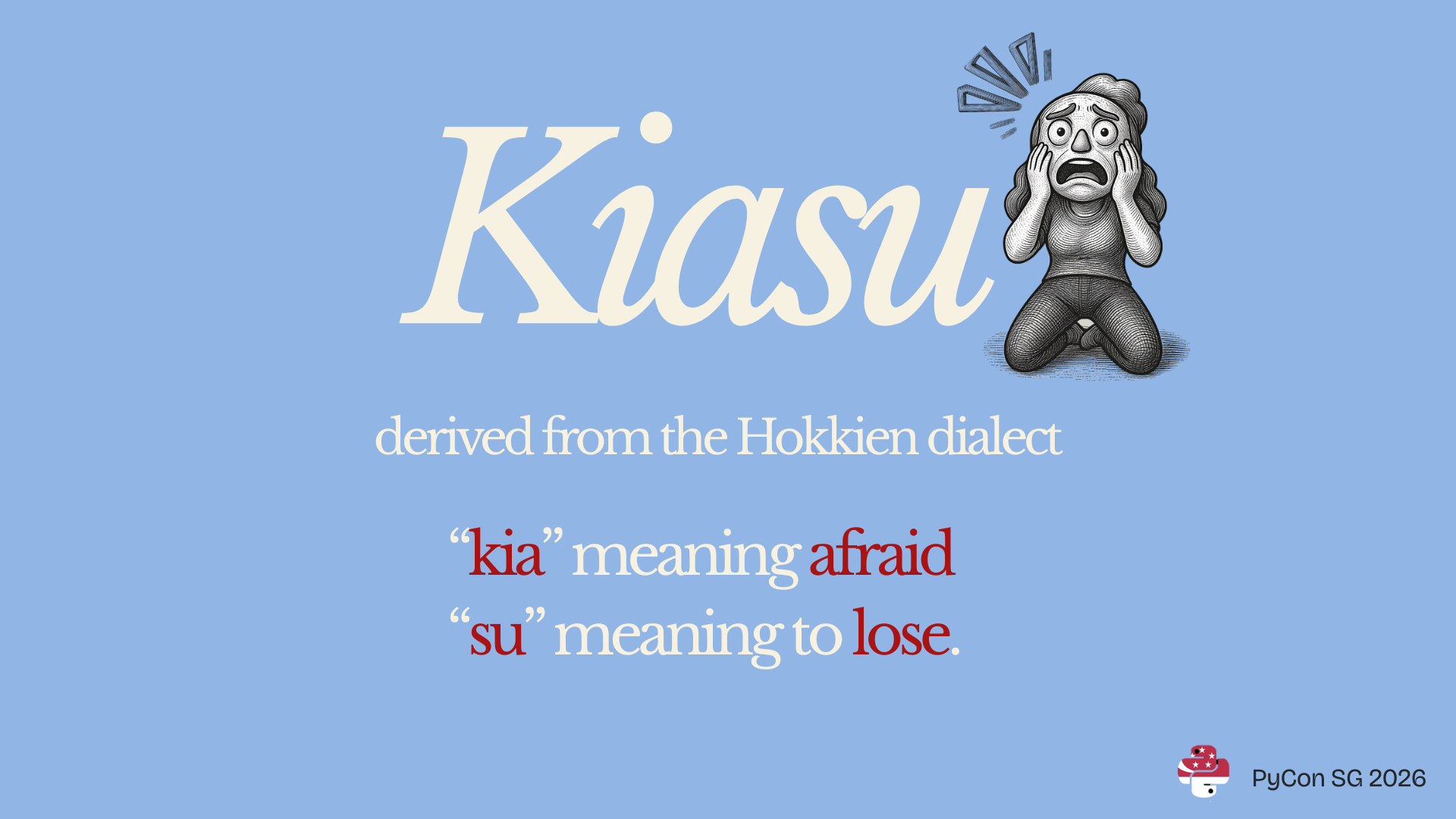
Kiasu comes from Hokkien dialect. Literally, it means being afraid to lose.
In Singapore, it is more than a word. It is a reflex, a joke, a parenting strategy and sometimes an entire philosophy of education compressed into two syllables.
Study hard. Get good grades. Enter a good school. Find a stable job. Then you will be safe.
I heard some version of this throughout my childhood. I suspect many people from my generation did.
I studied hard. I went to public school. I do not remember feeling much academic pressure until Primary 3, when I was around nine years old.
I was one of the top three students in my class, so the system moved me into 4A, where many of the strongest students in the year were placed.
That was when I realised my ranking depended on which class I was placed in.
Many of my new classmates came from families where English was spoken at home. Their parents were executives or professionals. Mine were not.
My old friends were in other classes. My new classmates did not spend much time with me, and I did not spend much time with them.
In the new class, the competition was harder. I went from being near the top to being one of the lowest-ranked students, so the following year I was moved back into a normal class.
There, I became one of the top students again.
So the system moved me back up.
Once I was in the higher-performing class, I fell towards the bottom again and was moved down once more.
For a while, my education ran like a for-loop:
Place me in a normal class.
I rise to the top.
Move me into the elite class.
I fall to the bottom.
Move me back down.
Repeat.
The result changed according to the class, but the loop remained the same.
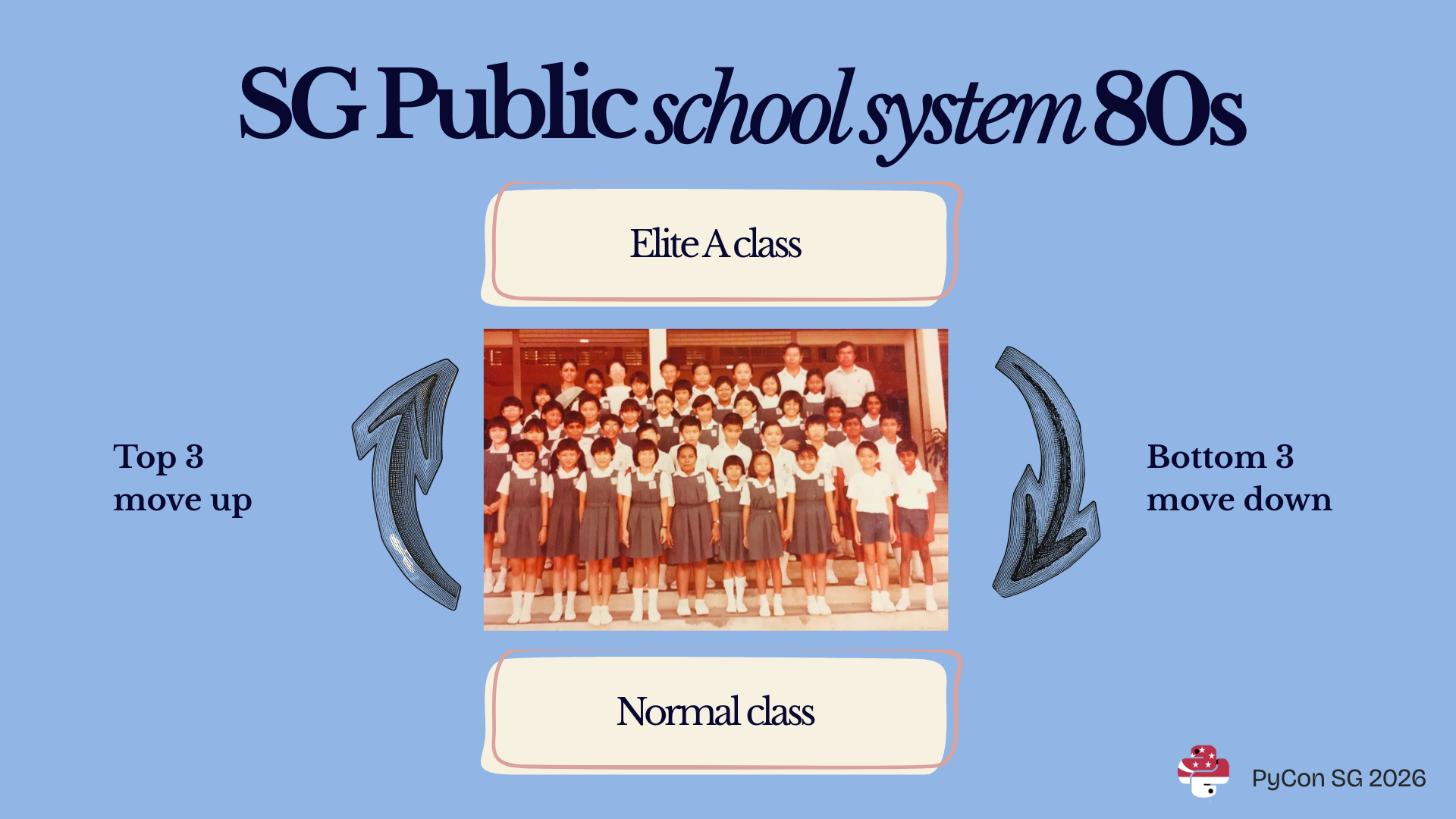
In one room, I was bright. In another, I was not bright enough. The system kept returning different judgments.
I was still the same child.
When 90% of the Class Did Not Understand
When I signed up to become a teacher, I signed a bond.
This was normal. The government would pay for my training, and in exchange I would owe several years of service. Leave early and I would owe money instead.
It seemed fair enough on paper.
Most arrangements seem fair enough on paper.
Before we received formal teacher training, we were assigned to schools for six months.
I was the main class teacher for a group of eight-year-olds and a subject teacher for children between ten and twelve. There were forty students in a class.
Alongside teaching, teachers completed weekly reports for heads of department and school leadership. The syllabus moved at a fixed pace. The reports documented that movement.
One week, I was teaching a particularly difficult mathematics topic.
By the end of the week, only four children understood it. Four out of forty. Ninety percent of the class did not understand.
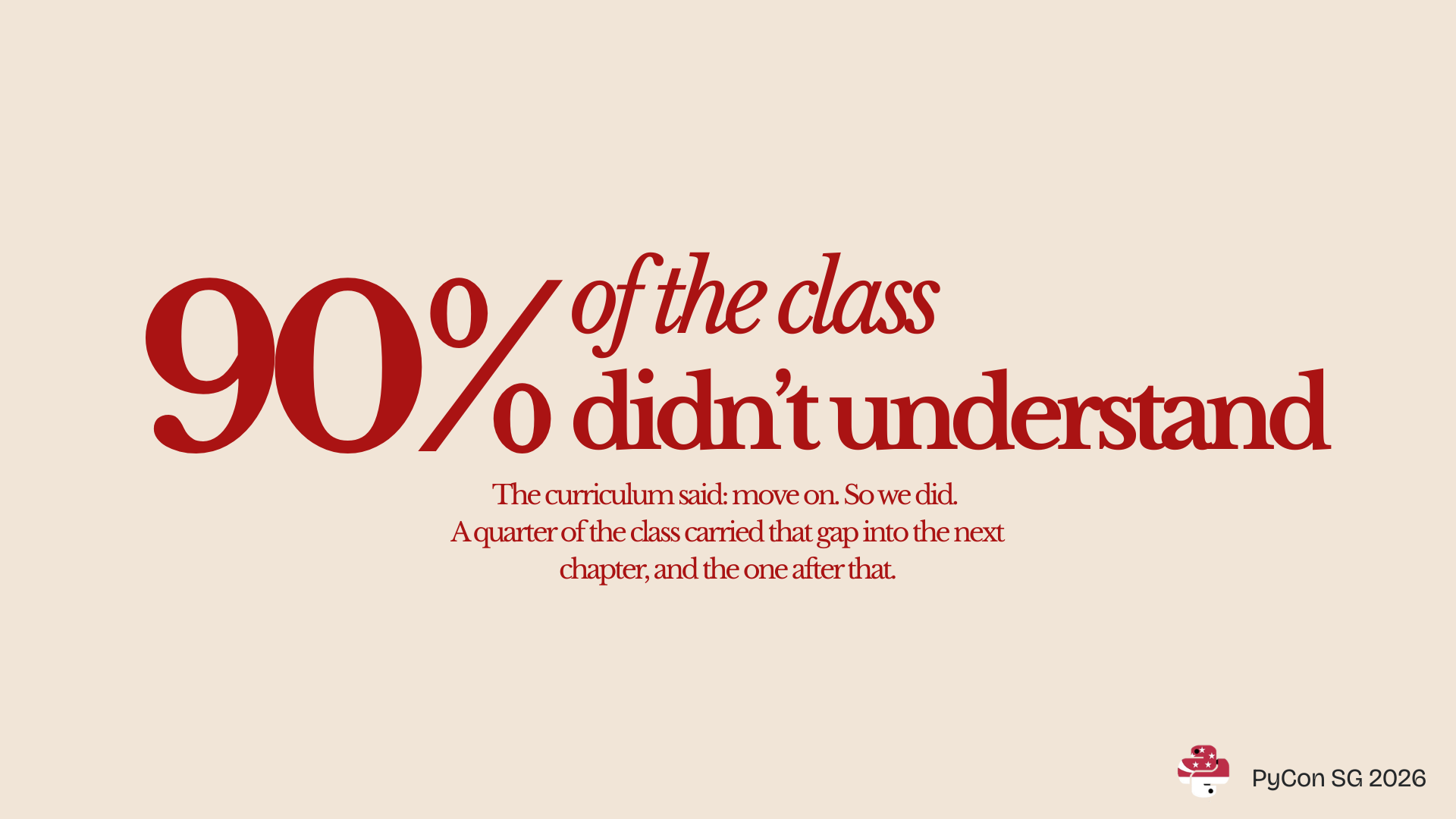
The following week, we were scheduled to begin another topic. I asked whether I could spend more time on the one we had just covered.
I was told I could not.
The syllabus said move on, so we moved on.
We left thirty-six children standing on a foundation that was not there, and we built the next floor on top of them anyway.
It would be easy to tell this story as though someone in the staff room had made a cold, deliberate decision to abandon those children.
That was not what happened.
The teachers were not uncaring. The head of department was not trying to harm anyone. Nobody arrived at school intending to leave children behind.
Every adult was doing what the system required.
The syllabus had to be completed. The next topic had to begin. The weekly report had to show that the class was moving according to schedule.
The system asked for completion, not comprehension. It asked the children to keep up or fall behind quietly. It asked the teachers to record that the chapter was done.
And we did. The system was not malfunctioning. It was functioning exactly as designed, optimised for the wrong thing.
Six months later, I began studying at NTU (Nanyang Technological University) to become a certified teacher.
There, I found that teachers were prepared through the same system used to educate students.
Consume the material.
Sit the examination.
Pass.
Graduate.
Then you are ready to teach. For me, that defeated the purpose of teaching. Teaching, to me, is listening.
It is watching a specific child fail to understand a specific thing, then changing your approach until something works.
It is noticing that a student’s silence does not mean “I understand,” but “I am confused.”
It is recognising that two children can give the same wrong answer for entirely different reasons.
The system I had entered had a slot for delivery. It had a slot for assessment. It had a marking pile tall enough to bury the listening completely.
So I quit.
Walking Away
Leaving had consequences.
I had signed a government bond for my teacher training, so walking away meant repaying the cost of that education. The amount continued to grow while I appealed and negotiated, and I spent nearly twenty years paying it back across several international moves.
The debt was difficult, but it was not why I left.
I left because I could not accept an education system that required teachers to move on while most of the class was still lost.
By many measures, Singapore’s education system is world-class. I will not pretend otherwise. But I am not an objective observer of it.
I experienced the system as a student and later as a teacher. I also paid a substantial price to leave it.
That history inevitably shapes how I see it.
This Was Never Only My Story
I built the talk expecting to share my story and let people decide what they thought of it.
What I did not expect was how many people would recognise parts of their own lives inside it.
One attendee found me afterwards, and we talked for far longer than the usual handshake and long discussion that follows a keynote. We did not talk much about AI. We talked about Singapore’s education system, and about how closely my story resembled something he had been carrying privately for years.
He was not responding to a talk. He was responding to recognition.
I had described a room he had also stood in, and for a while, he wanted to stand there with someone else.
That conversation has stayed with me more than any compliment or photograph. It confirmed something I had suspected but could not prove until I said the story aloud:
This was never only my story. I just had the microphone.
A teacher came to find me too. He told me about his children, and about trying to help them find lives that suited who they were rather than the narrow idea of success expected of them.
I do not think he needed my permission. Perhaps he needed to hear someone say plainly that there is no single correct ladder.
The ladder was always a story we agreed to believe. It was never a law of physics.
Michelle later wrote about the talk, and her reflection helped me see that the question was larger than whether students and teachers were ready for AI.
The real question was whether an education culture built around correct answers could survive a world in which answers had become almost free.
Iqbal wrote a blog with nearly fifteen hundred words the next day. He took the argument somewhere I had not yet finished taking it myself: AI is not the disease. It is the mirror. The system has been standing in front of that mirror for years, blaming the lighting.
He added a fifth imperative to the four I had offered in the talk:
Stay inconvenient.
Be the person who still reads the entire hundred-page document.
I am keeping that one.
What if Schools Looked More Like Open Source?
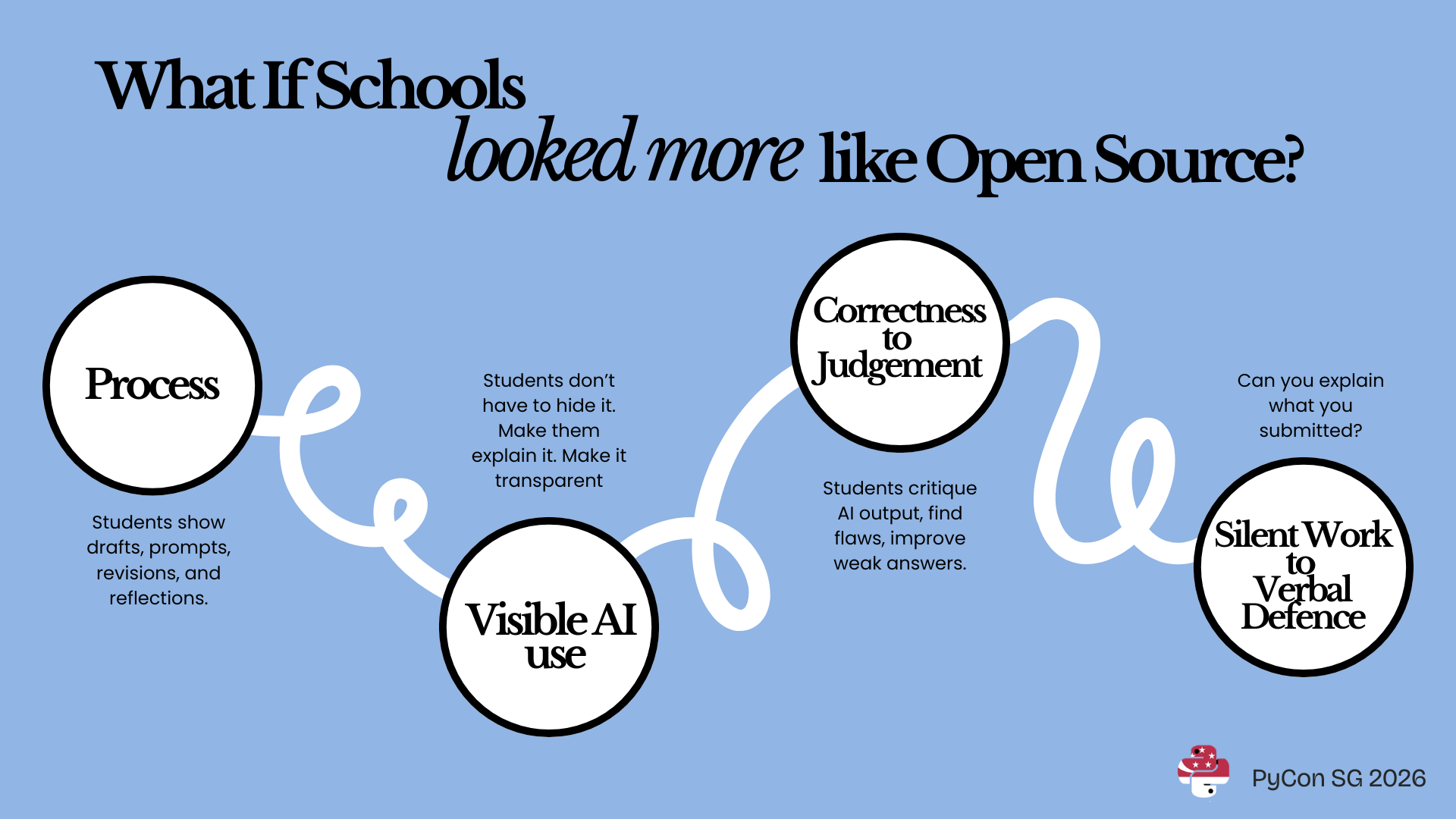
Not chaotic.
Not unstructured.
Not “children, go forth and GitHub yourselves into enlightenment.”
Healthy open-source projects have maintainers, contribution guidelines, documentation, review processes, codes of conduct, mentorship and governance. They are open, but they are not without structure.
What education could borrow from open source is not the software. It is the way learning remains visible.
In open source, the final code is only part of the record. You can often see the problem that started the work, the first attempt, the questions, the review, the changes and the reasons behind them. The polished result does not appear from nowhere. Its history is part of the contribution.
Learning should work the same way.
A student should be able to show where an idea began, how it changed and what caused that change. If AI was involved, that should not need to be hidden or smuggled past the teacher. The important question is not whether the machine touched the work. The important question is whether the student exercised judgment.
What did the student ask?
What did AI suggest?
What was inaccurate, shallow or irrelevant?
What did the student change?
What can they now explain without the tool?
In that environment, AI output is not an answer key. It is closer to a pull request.
It may be useful. It may also be incomplete, poorly reasoned or confidently wrong. Students should not accept an AI response just because it sounds polished and convincing. It has to be reviewed. It has to make sense.
Open source also gives learners the chance to leave something behind.
A person may begin in open source by following documentation written by someone else. Later, they may help others by improving an example, rewriting unclear instructions, translating documentation, or answering a beginner’s question.
Students could learn in the same way. They may begin by using notes, examples, or explanations created by others. Once they understand the subject, they could improve those materials or create a clearer explanation for the next group of students.
The learner gradually becomes a contributor.
That is a profound shift from the way school often works. Students normally produce work for one teacher, receive a grade, and then watch the work disappear into a drawer or an online portal. Before long, they may also forget much of what they learned.
But what if part of learning was making the path clearer for the person who came next?
A student who finally understands a difficult concept might write the explanation they wish they had received. Another might improve an example that confused the class. Someone else might translate it for a student who learns in another language.
The work would no longer exist only to prove that learning had happened.
It would become part of the learning environment itself.
In this model, the teacher is not the repository of knowledge.
The teacher is a maintainer of the learning environment.
A good maintainer does not personally create every contribution. They uphold standards. They review work. They protect newcomers. They explain the rules nobody wrote down. They notice where participation breaks. They help people move from using something to taking responsibility for it.
That is also what a good teacher does.
The Stains

The claim I am making is larger than my own grievance.
This is not only a Singapore problem.
Singapore did not invent these problems. It simply runs the system more efficiently than many other countries.
Technology changed. Work changed. The way we communicate changed. The way we find information changed. The world kept moving, but some assumptions buried inside education remained untouched.
The system is like a stained uniform. You can still wear it. It is not useless, and it is not beyond repair. You can still put it on, go to school, and receive a good education.
But you cannot pretend the uniform is spotless.
AI is the harsh overhead light that has made the old ink impossible to ignore.
Meritocracy Stain
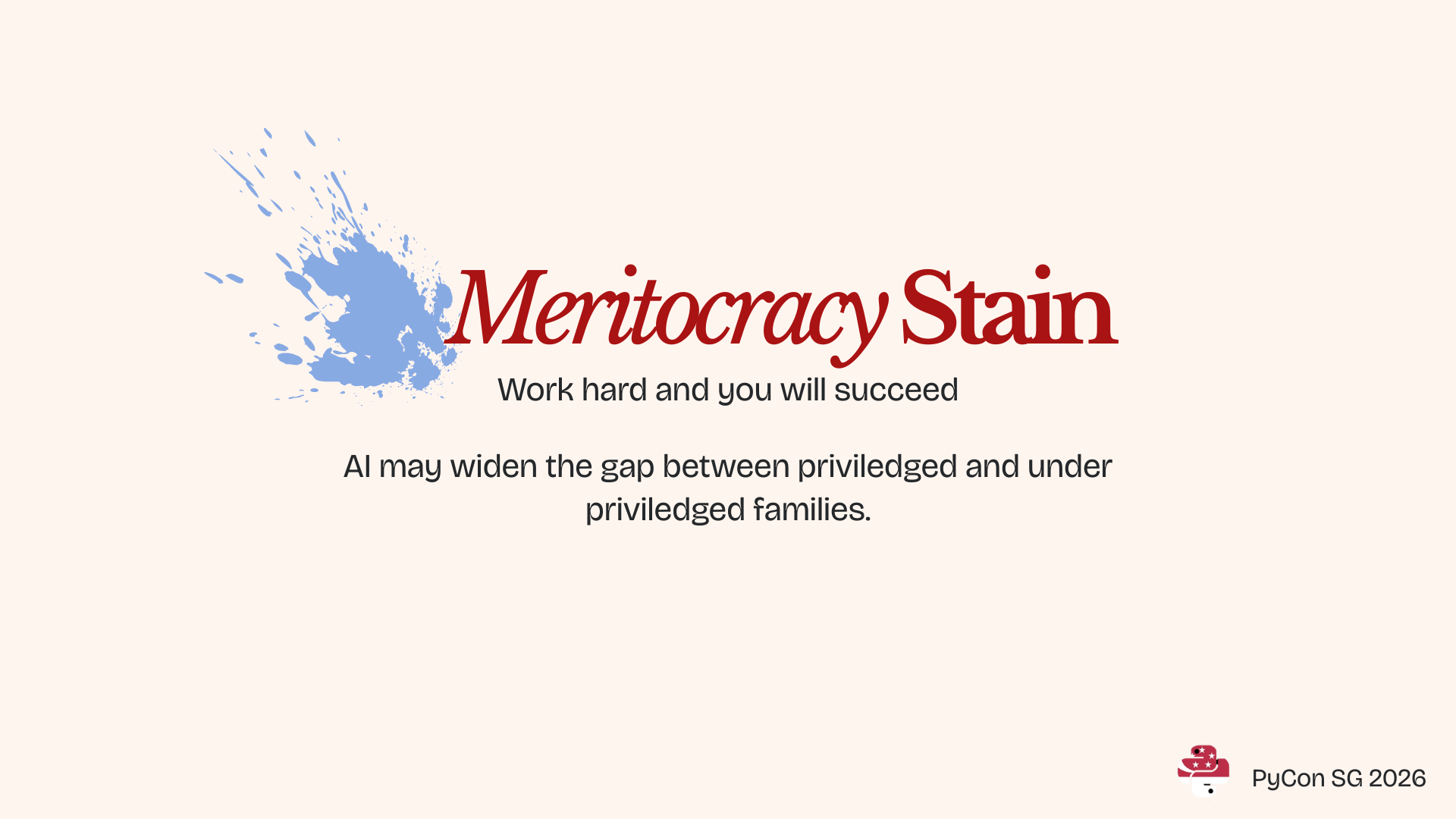
There is the meritocracy stain.
We tell children that if they work hard, they will succeed.
The hidden clause is rarely printed.
Work hard, and have parents who understand the system.
Work hard, and have a quiet place to study.
Work hard, and have the right language spoken at home.
Work hard, and have money for tuition.
Work hard, and have someone who can explain why your essay has no argument, why your answer only sounds correct, or why you should try again after failing.
AI will not automatically remove this inequality.
It may deepen it.
Advantaged families will not merely ask AI for answers. They will use it for strategy, revision plans, interviews, writing feedback, confidence and career preparation.
The wealthy have never only purchased tools.
They purchase interpretation.
Exam Stain
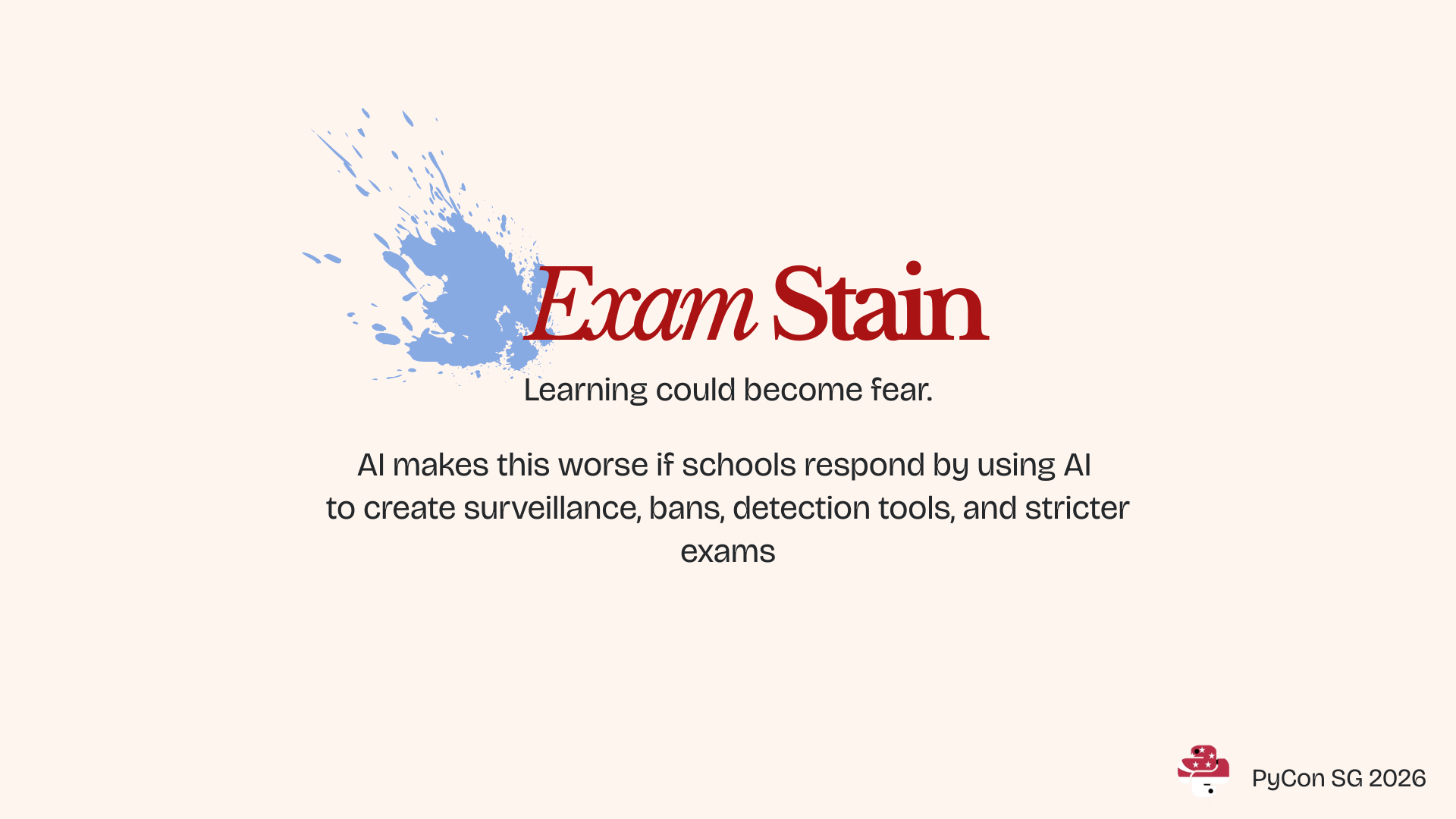
And there is the exam stain.
Exams are not inherently bad. They can serve a useful purpose.
But when the examination becomes the soul of education, learning contracts around it.
Students learn to perform understanding.
Teachers learn to reverse-engineer marking schemes.
Parents learn to panic earlier.
Schools learn to protect their numbers.
If the only response to AI is surveillance, detection software, bans and stricter examinations, education becomes a police procedural with worksheets.
That is not a new future.
It is a more anxious version of the past.
Sifu Stain
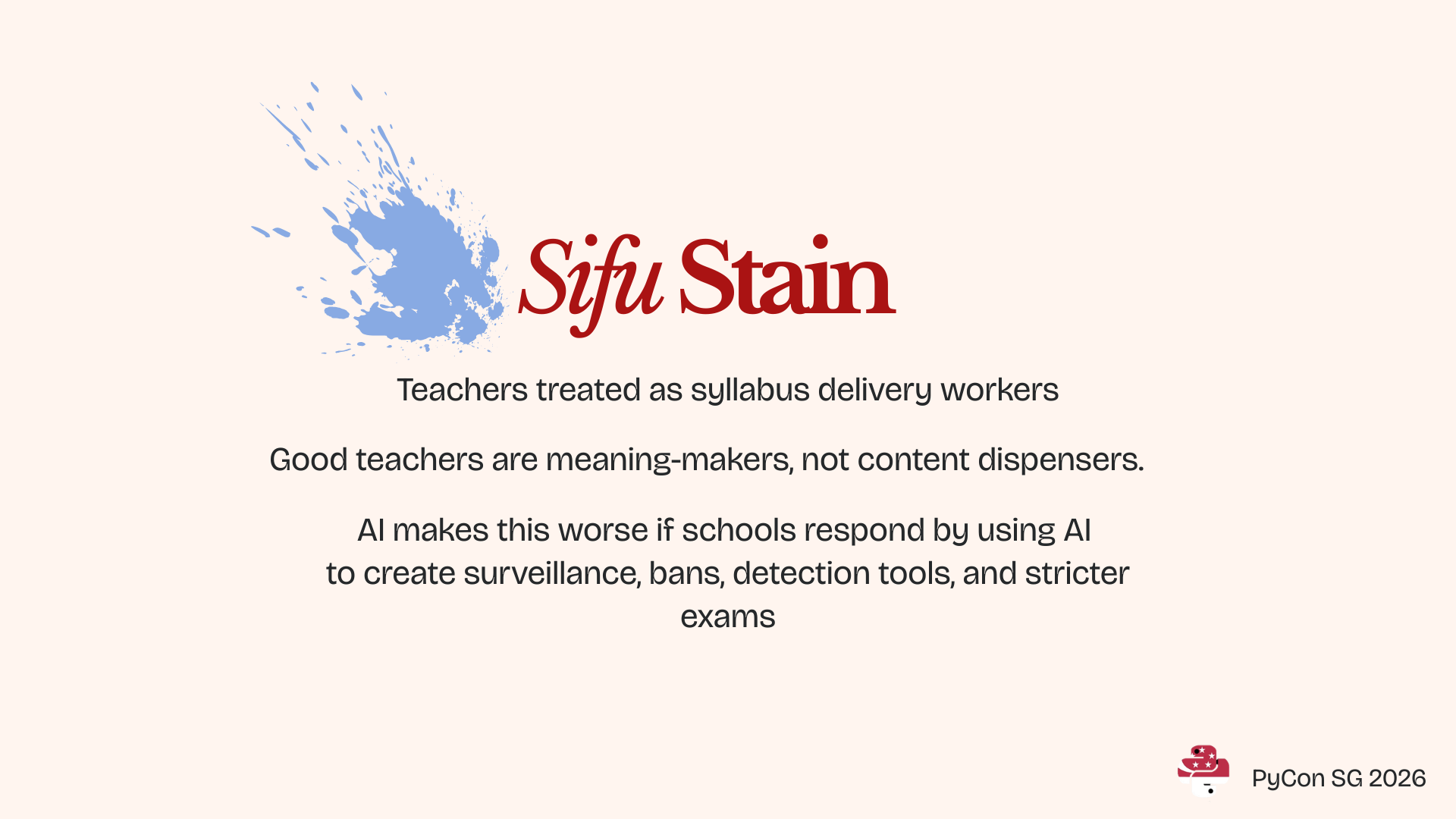
Then there is what I think of as the sifu stain.
Sifu means master or teacher. It carries the image of the person at the front of the room who possesses knowledge and passes it down.
Education systems say teachers are important, then treat them as syllabus-delivery workers with marking piles and no authority to slow down for thirty-six confused children.
When AI enters the classroom, the first fear is often that students will know how to use it better than their teachers.
Gen Z and Gen Alpha may well understand the tools more quickly. They have grown up inside different technological weather.
But this fear rests on an old misunderstanding of teaching.
Good teachers were never valuable because they knew the most.
The Teachers We Remember
Think about your favourite teacher.
Not necessarily the one whose subject gave you the highest grade.
Not necessarily the most knowledgeable person you met at school.
Why do you remember them?
Perhaps they noticed you were struggling and did not move on without you.
Perhaps they found an unorthodox way to explain something that had refused to make sense.
Perhaps they gave you confidence before you had enough of your own.
Or perhaps they helped you find a path towards the answer rather than simply handing you the next one.
This human knowledge is the key.
But knowledge is the raw material. Teaching is what happens when that material meets a particular person at a particular moment.
Good teachers listen.
They notice.
They adapt.
They know that silence can mean concentration, fear, boredom or surrender, and that the difference matters.
They can tell when a student has memorised the words but not understood the idea.
This is why I do not believe senior teachers automatically become less valuable in an age of AI.
Age does not make a person outdated.
Refusing to keep learning can.
Senior teachers may struggle if they think their role is to know more than their students. But their real value lies in recognising when a student is afraid, confused, pretending to understand, or capable of more.
AI can generate an encouraging response.
It can explain a concept ten different ways.
It can produce a worksheet, a lesson plan, a summary and a model answer before a teacher has finished their morning coffee.
But it does not share responsibility for what happens to the child after the screen is turned off.
A teacher does.
That responsibility changes the relationship.
A teacher may remember that a child stopped raising her hand after being laughed at.
A teacher may remember why a child stopped raising her hand after being laughed at. They can see when the student labelled lazy is actually lost, or when the loudest child in the room is using performance to cover fear.
That is not information retrieval.
It is human calibration.
The teacher’s future does not lie in competing with AI to produce more facts.
That contest is already over.
The teacher’s future lies in helping students judge, question, connect, recover, contribute and care.
The best teachers were doing that all along. Nothing has changed.
The Learning System That Worked
I left one learning system that disappointed me but years later, almost by accident, I found another that did not.
Open source.
Nobody in open source asked for my certificate.
Nobody asked whether I was the smartest person in the room, which was convenient because I was not. I am still not. 😅
I am not a computer science graduate. I am not a star programmer. I learned programming by trying things, asking questions, making mistakes, breaking things, and working around them until they worked.
That was enough for me to begin contributing, then organising, and eventually helping other people find their own way into the community. Years later, I was elected as a Director of the Python Software Foundation, helping to steward a language I had largely learned by getting things wrong.
The education system I left had no place for a story like that.
There was no examination for showing up, staying curious, helping people, and learning in public for a decade, yet those were the experiences that shaped the work I eventually came to do.
Python did not become one of the world’s most widely used programming languages because it was perfect.
It is not perfect.
Python has performance limitations, packaging scars, historical peculiarities and enough conflicting opinions to power several conferences indefinitely.
Python grew because it was learnable, shareable, teachable and surrounded by people who kept opening doors.
People entered through tutorials, documentation, local meetups, user groups, conferences, libraries, bug reports and other people.
They did not all begin as experts.
They were allowed to participate before they were fully ready.
That was not merely a technical achievement.
Open source is a culture, and it offers evidence of what a successful learning environment can become. For a long time, people struggled to believe that something freely available could survive, let alone grow. But open source was never free to create. It was built through the time, effort and care of thousands of contributors.
The software may be free to use. The learning behind it is sustained by people who write documentation, mentor newcomers, review contributions, share knowledge, and help others understand.
That human exchange is what made the learning environment work.
AI did not break Education
AI did not break education.
It revealed the bug.
The bug was never that teachers did not know enough.
The bug was that we designed systems around the delivery and reproduction of knowledge, then treated that process as learning.
We rewarded completion over comprehension.
Polish over curiosity.
The correct answer over the difficult human work of arriving there.
Now a machine can produce the polished answer in seconds.
That does not make good teachers obsolete.
It makes our old definition of teaching obsolete.
Stay Inconvenient
I carried this story for more than twenty years before speaking about it publicly.
For a long time, it was simply the story of why I had left teaching. It took AI arriving for me to see the wider question underneath it.
The problems AI is revealing did not begin with AI. They were already present in the way we define learning, measure success and treat teachers.
Perhaps it took AI arriving to make the shape visible.
To make the old ink run under the harsh light.
But revealing the bug is not the same as fixing it.
Open source taught me that people do not need to begin as experts. They need a way in, room to make mistakes, and people willing to help them improve.
Over time, they can begin contributing, take on more responsibility, and help others enter too. They should also be free to ask difficult questions, even when those questions slow everyone down.
The questions we ask now matter more than the answers AI can generate.
Why did we move on when most of the class did not understand?
Why do we reward the final answer while paying so little attention to how a student reached it?
And why are we so worried about AI replacing teachers when we have spent years reducing teaching to the delivery of information?
AI can answer questions. The harder work is deciding which questions are worth asking, whose answers are missing, and whether we are willing to remain in the room long enough to hear them.
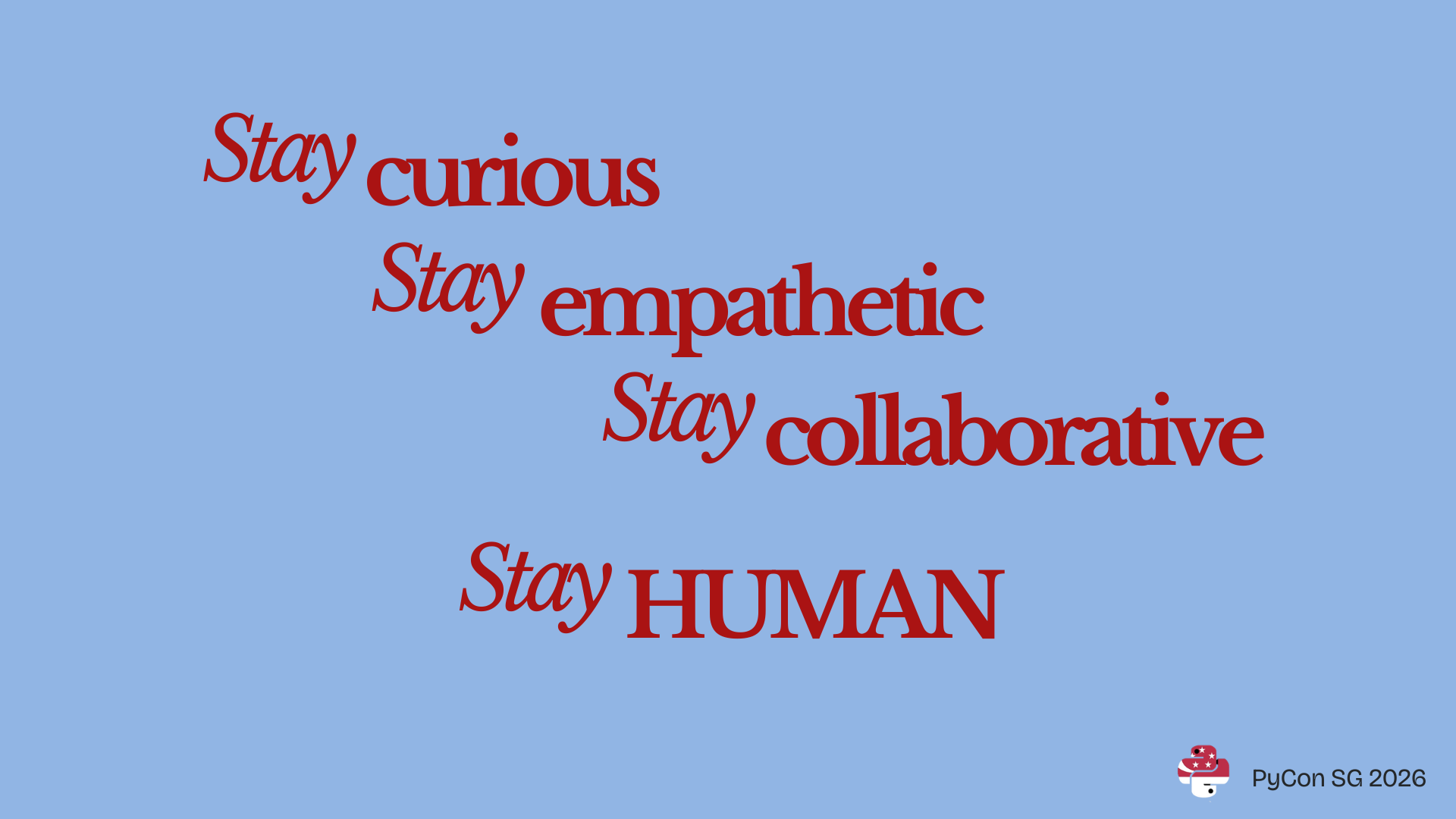
AI may replace tasks, but it cannot replace curiosity, empathy, collaboration, or the ability to help another person learn.
We spent decades trying to become smarter than the computer. Then the computer got smarter than us.
So maybe it’s time to become more human.
Georgically speaking
Talk and Reflections
So Kiasu, Still Kena Replaced by AI — PyCon Singapore 2026